

Before You Scale AI in Marketing, Build the Guardrails
Nobody approved AI in your marketing department. It arrived one subscription at a time.
A marketing manager expensed a seat. A designer started running concepts through an image generator. Somebody on the paid team found a tool that writes ad variants. None of it went through procurement. None of it went through legal.
The gap is wider than most leaders think. McKinsey’s workplace AI research found that C-suite executives estimate 4% of employees use generative AI for at least 30% of their daily work. Employees put that number at 12%, roughly three times higher.
The risk is not the tools. The risk is that no two people on your team are using them the same way. AI governance for B2B marketing teams exists to fix exactly that, and the version that works speeds the work up instead of slowing it down.
Shadow AI Is Already in Your Workflow
Unmanaged adoption has a look to it. You have probably seen at least one of these in the last month.
- Personal accounts. Work happens in consumer logins tied to somebody’s personal email. When that person leaves, the prompt history, the custom instructions, and the institutional knowledge walk out with them.
- Client data in prompts. Someone pastes a confidential brief, a pricing sheet, or an unreleased product spec into a free tool to get a first draft moving.
- Unreviewed output entering the workflow. AI-drafted copy reaches a client without a human check, carrying a statistic nobody sourced or a claim nobody can support.
- No disclosure conversation. Nobody has asked the client whether they want to know, and nobody has checked whether the client’s own policy allows it.
- A dozen house styles. Everyone prompts differently, so the output voice drifts and somebody spends their afternoon rewriting it back into consistency.
None of this comes from bad intent. It comes from capable people moving fast with no agreed rules. That is the entire problem AI governance for B2B marketing teams solves.
The Four Questions Every AI Policy Has to Answer
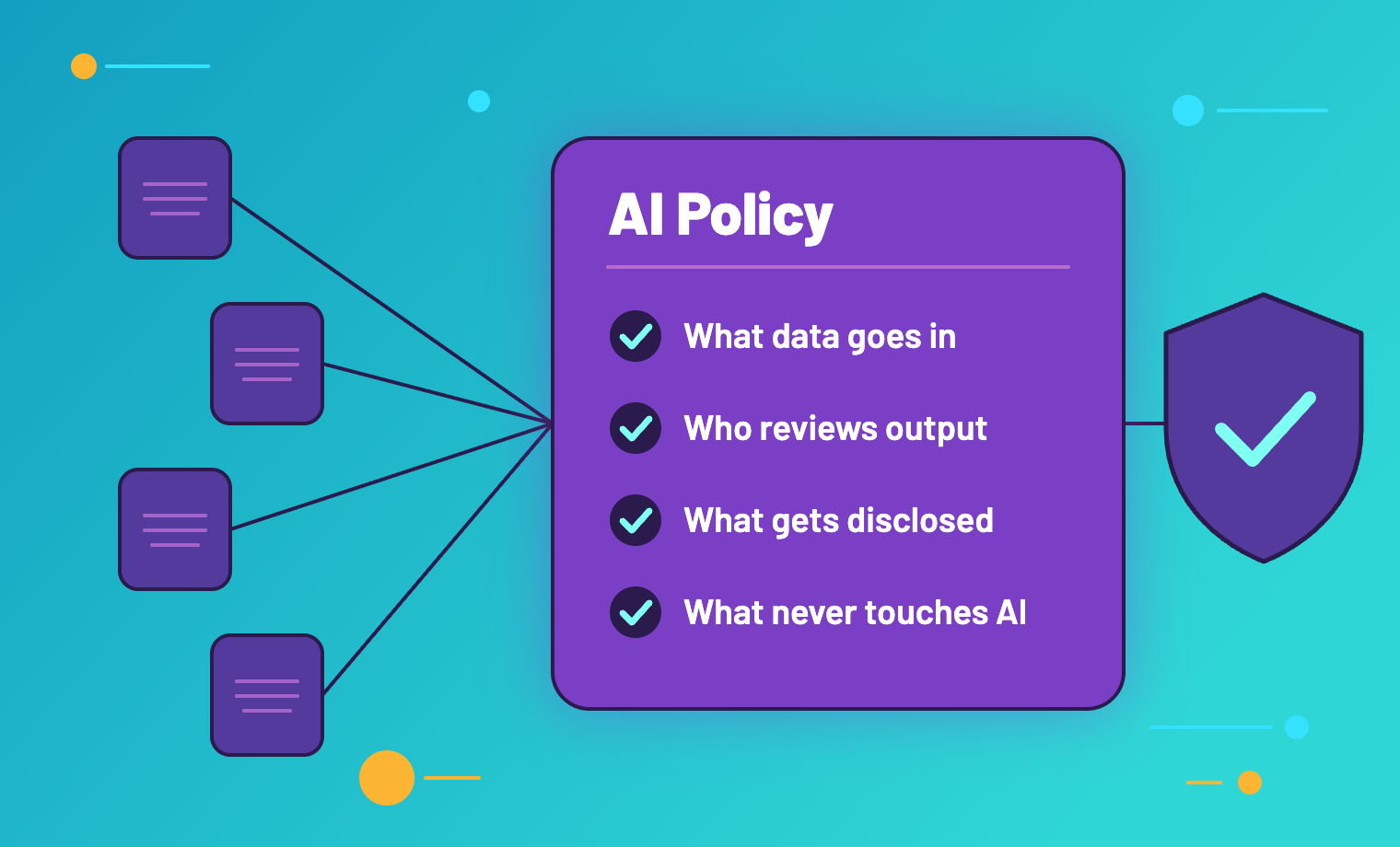
You do not need a forty-page document. Most of AI governance for B2B marketing teams fits into four questions, written down, that anyone on the team could answer out loud.
- What data goes in. Name what is allowed and what is never allowed: client confidential material, unreleased information, personal data, anything under NDA. Be specific enough that nobody has to guess under deadline.
- Who reviews output. Every piece of AI-assisted work gets a named human owner before it leaves the building. Review is a role, not a good intention.
- What gets disclosed. Decide what you tell clients about how you use AI in their work, then tell them the same thing every time. Ask what their policy requires of you while you are at it.
- What never touches AI. Some work stays human. Regulated claims, crisis communications, anything where a small error is expensive. Draw that line before you are up against a deadline, not in the middle of it.
Write the answers down. An unwritten policy is a preference, and preferences do not survive a busy quarter.
Tier the Risk, Don’t Ban the Tools
A blanket ban does not stop AI use. It moves it somewhere you cannot see it.
The more useful approach is the one NIST takes in its AI Risk Management Framework, a voluntary standard built around understanding context before judging risk. Its Map function exists for a reason: the same tool carries very different stakes depending on what you point it at. For a marketing team, three tiers usually cover it.
- Low risk: internal work. Brainstorming, summarizing a meeting, reorganizing an outline, drafting an internal doc. Light review, use freely. This is where most of the speed lives.
- Medium risk: client-facing work with a human in front of it. Blog drafts, campaign concepts, first-pass copy. AI assists, a named person edits and owns the result.
- High risk: claims, data, and regulated content. Performance statistics, competitive comparisons, anything with legal or compliance exposure. Human-authored, human-verified, and documented.
Tiers do the thing a ban cannot. They tell your team where to move fast and where to slow down, which is the only instruction most people actually need.
What Changes in Regulated Industries
If your clients work in financial services, healthcare, or another compliance-sensitive vertical, the rules are not waiting for you to write yours.
FINRA has been direct about it. Its guidance on generative AI states that its rules are technology-neutral and continue to apply when firms use the technology, and that its content standards for communications with the public apply the same way to technology-generated communications as to human-generated ones.
There is no AI exemption. What that means in practice:
- Review trails. You need to show who reviewed what, and when. “The tool wrote it” is not a review.
- Records retention. AI-assisted communications are still communications. They get retained on the same schedule as everything else.
- Disclosure expectations. Regulated clients often have their own AI policies that flow down to vendors. Ask before you assume.
- Substantiation. Every claim still needs a source a compliance officer can follow. A model’s confident phrasing is not a citation.
The SEC’s marketing rule for investment advisers sets a similar bar. Nothing about AI loosens it.
Where Strategy Still Comes First
Before building, we had to answer a key question: what counts as campaign “success” when performance data is limited? We chose observable, defensible signals, then built the taxonomy—firm type, key messages, channel, agency—so comparisons would hold up.
The hardest call was evidentiary. Every claim needed a traceable public source: a press release, award listing, or press link. Unverified campaigns came out; unresolved gaps were named.
That part does not automate.
Custom AI marketing tools can assemble, sort, and summarize. They cannot define evidence or flag what is missing.
Take the Next Steps Toward AI Governance.
AI governance for B2B marketing teams is not a project that ends. It is a short set of decisions you make once and revisit as the tools change.
If you cannot say what AI is being used for across your marketing function right now, that’s where to start. Reach out to the BFTeam, and we will work through it with you.
