

2027 Marketing Budget Planning Starts Now, Not in November
If your 2027 budget conversation starts in November, the decisions have already been made without you.
Most B2B organizations run a calendar fiscal year. That means finance is shaping 2027 topline numbers in the upcoming weeks, and marketing requests get locked sometime in Q4. August is when the numbers are still soft.
This year the request is harder to write than usual. Leadership wants more results, on a flat budget, while the organization figures out AI. That is the conversation you are walking into. Here is how to walk in early and prepared.
Why August, not November
Finance drafts the topline in late summer. Marketing either shapes that number or inherits it. There is no third option.
And a budget built backward from revenue goals is not a one-afternoon exercise. Pipeline math, channel history, honest assessment of what is missing—that work takes weeks. Showing up in November with a wish list reads as a wish list. Showing up in August with math reads as planning.
Start with the math, not the wish list
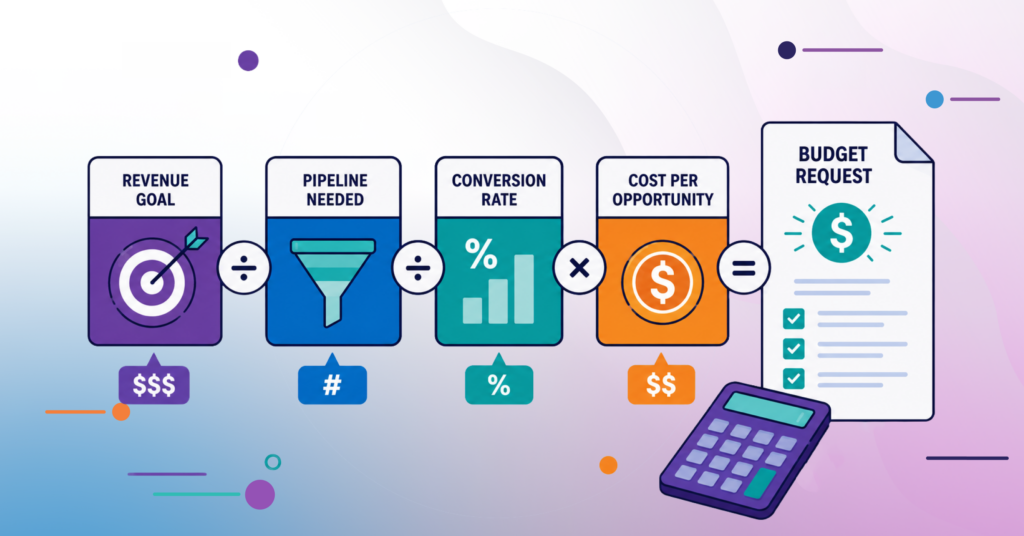
Work backward from the 2027 revenue target. How much pipeline does sales need to hit it? At your actual conversion rates, how many opportunities does that require? At your actual cost per opportunity by channel, what does generating them cost? That chain of numbers is your request.
For a reality check on the total, Gartner’s 2026 CMO Spend Survey puts marketing budgets at 7.8% of company revenue, essentially flat from 7.7% the year before. Useful context, with one caveat: that panel skews heavily toward companies above $1 billion in revenue. Treat it as a directional benchmark, not a target for a mid-sized organization.
Then audit 2026 before you ask for 2027. Separate what produced pipeline from what produced activity. Those are different columns, and the second one is where the funding for your new priorities is hiding.
Which is the point we have made before: spend level matters less than spend allocation. A bigger budget spent the same way produces the same results, slightly louder.
Budget for the AI transition, not an AI experiment
Gartner found CMOs now allocate 15.3% of marketing budgets to AI—while only 30% say they are ready to scale it. Budget without readiness is the new version of waste.
The organizations that report real AI maturity are not just spending more on AI; they pair the spend with the data, process, and training to use it.
Three AI line items worth planning deliberately:
- Tools and licenses. Consolidate the pilot-tool sprawl before you add anything. Most teams are already paying for overlapping subscriptions nobody has audited.
- Capability building. Training, workflow redesign, and the hours it takes to change how work gets done. This is the line most budgets skip, and it is the one that determines whether the tools produce anything.
- Content and search shifts. As buyers start their research in AI answers instead of a results page, answer engine optimization and AI visibility work become their own scope.
What funds it: the channels that report impressions but cannot show pipeline. You already know which ones those are.
One structural note—do not fund AI as a separate innovation bucket. It gets treated as optional and cut first. Fund it inside the channels it actually changes, where it has to perform against the same numbers as everything else.
Structure the request so it survives the CFO
Four things make a marketing budget defensible in a finance conversation:
- A quarterly reallocation checkpoint. A 2027 budget locked in October 2026 will be wrong by June, and saying so upfront buys credibility rather than costing it.
- Three scenarios—hold, grow, aggressive—each tied to a revenue outcome rather than a list of tactics. Let leadership choose an outcome and buy the plan that produces it.
- A clean split between run-the-business spend and build-the-future spend, so the AI investment is visible instead of buried in line items.
- Commitment to the metrics finance already cares about: pipeline, revenue influence, sales cycle length. Not clicks.
The teams with budget for this started in August
The organizations that walk into 2027 funded for the AI transition are the ones having the conversation right now, while the numbers are still moving. If you want a second set of eyes on your budget math, or help thinking through the AI line items, the BFTeam is here.
Where does your 2027 budget conversation stand today?
