


Anthropic recently published a playbook on AI-native software development. Its big idea: code is no longer the bottleneck.
Building now takes hours, not weeks (reminder: This is in an AI-native software development setup; which is a certain subset of developers). The slow parts are the human-speed steps around it: planning, review, and deployment.
We build some AI-enabled tools for our clients, so we read it closely. A lot of it rang true. Our model is a little different, and the difference matters.
What the Playbook Gets Right
Building is dramatically faster. Code used to be the expensive part. Now the real question is what’s worth building.
Humans also stay accountable for judgment. The playbook’s closing line says human judgment stays above the loop. We agree.
It’s written with large engineering teams in mind, where cycle time is the number that matters.
Why Our Model is Intentionally Different
Our clients don’t hire us for faster builds. They hire us for deep knowledge of their industry and a team that applies it to their problem.
A faster build doesn’t teach us a client’s buyers, channels, or constraints. Picture a manufacturer with a 12- to 18-month sales cycle and engineers and procurement in the buying seat. A tool built quickly without knowing that is just a fast wrong answer.
That understanding is what makes a tool worth building. (It also takes time. No shortcut there.)
Where the Time Actually Goes in Tool Builds
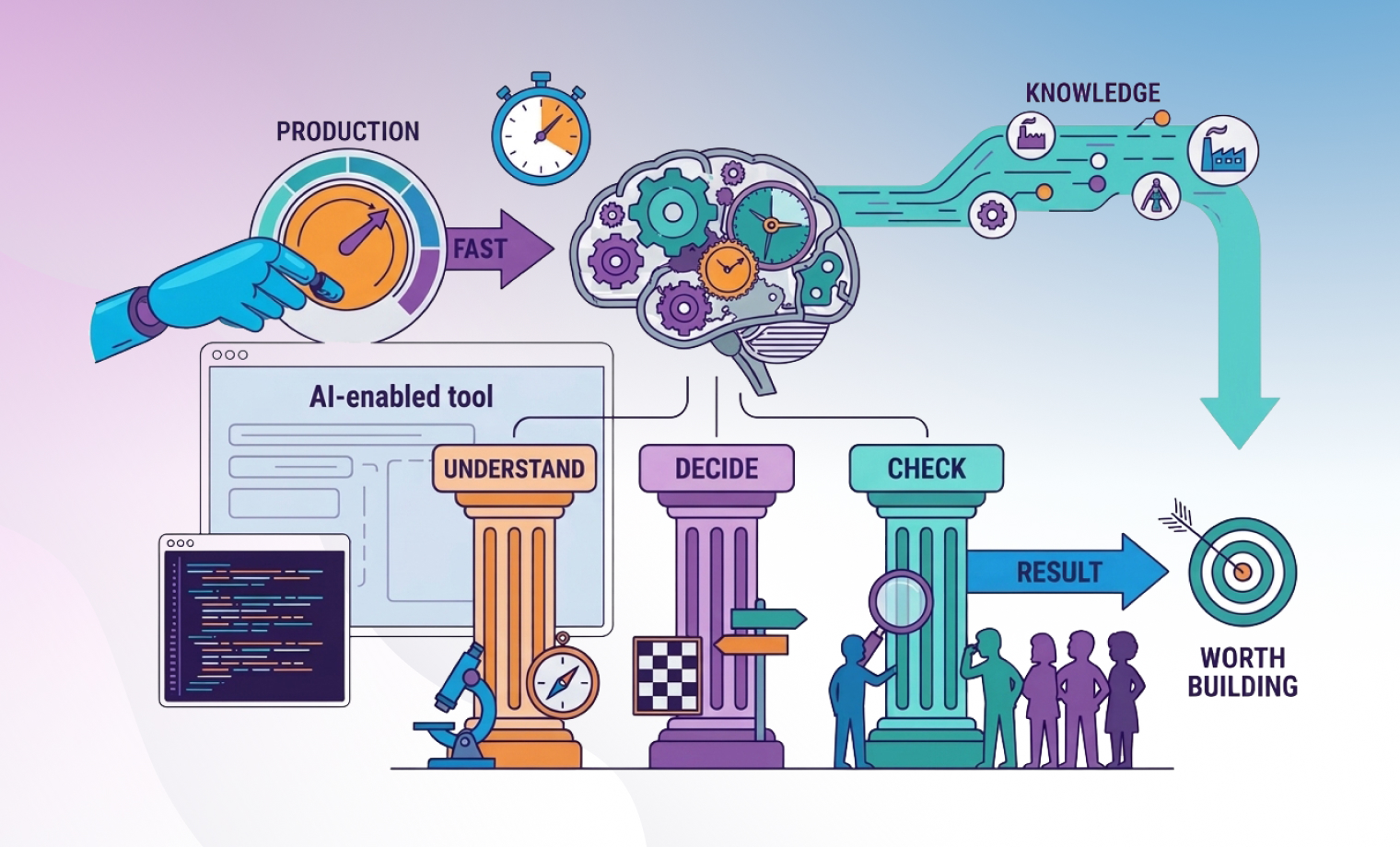
When we build a tool, most of our hours go to three things:
- Understand: the industry and the real problem we’re solving
- Decide: what’s actually worth building
- Check: the output against what we know about the buyer
“
The biggest risk with AI isn’t that it fails. It’s that it confidently gets things wrong. An AI tool that doesn’t understand a client’s products, customers, and context can do more harm than good. Our long-standing client relationships tell us which information matters, so the tools we build are accurate from day one. That’s when AI’s speed actually pays off: when you already know what’s worth building.”
– Rob Christensen, Senior Developer

AI shortens the production work. We put that time back into strategy and review.
In fact, the more AI we use to produce, the more carefully we steer and check. Faster output means more to review.
Think of it as a dial. AI moves production time, not expertise time.
The hours don’t disappear. They move to the work that needs expertise.
Who the AI-Native Approach Fits
The AI-native approach fits high-volume software teams with well-defined specs. It fits smaller builds. Or anyone competing on turnaround.
If speed is what you’re buying, that approach makes sense. For us, it’s not the point. That’s a real advantage for those teams, and we’re not knocking it.
Three Questions for Any Partner
Speed is great. It’s just not what makes a tool useful. So when someone says AI makes everything faster, ask:
- Faster at what? Production speed and good decisions aren’t the same thing.
- Who decides what gets built? Someone should own that call and know the industry.
- Where does the industry expertise come from? Not from the model alone.
