

Your buyers are not scrolling a page of blue links anymore. They are reading an answer.
Pew Research found that when a Google search returns an AI summary, people click through to a result in 8% of visits. Without a summary, that number is 15%. Roughly a quarter of those sessions end right there, on the results page.
For publishers, that is a traffic story. For B2B, it is a positioning story. Buyer research happens early and quietly, months before anyone fills out a form, and answer engine optimization for B2B is simply the work of showing up in that research. If your content is not built to be pulled into those answers, you are invisible at the exact moment it happens.
What’s Actually Changing
Search engines used to route people. Now they answer them.
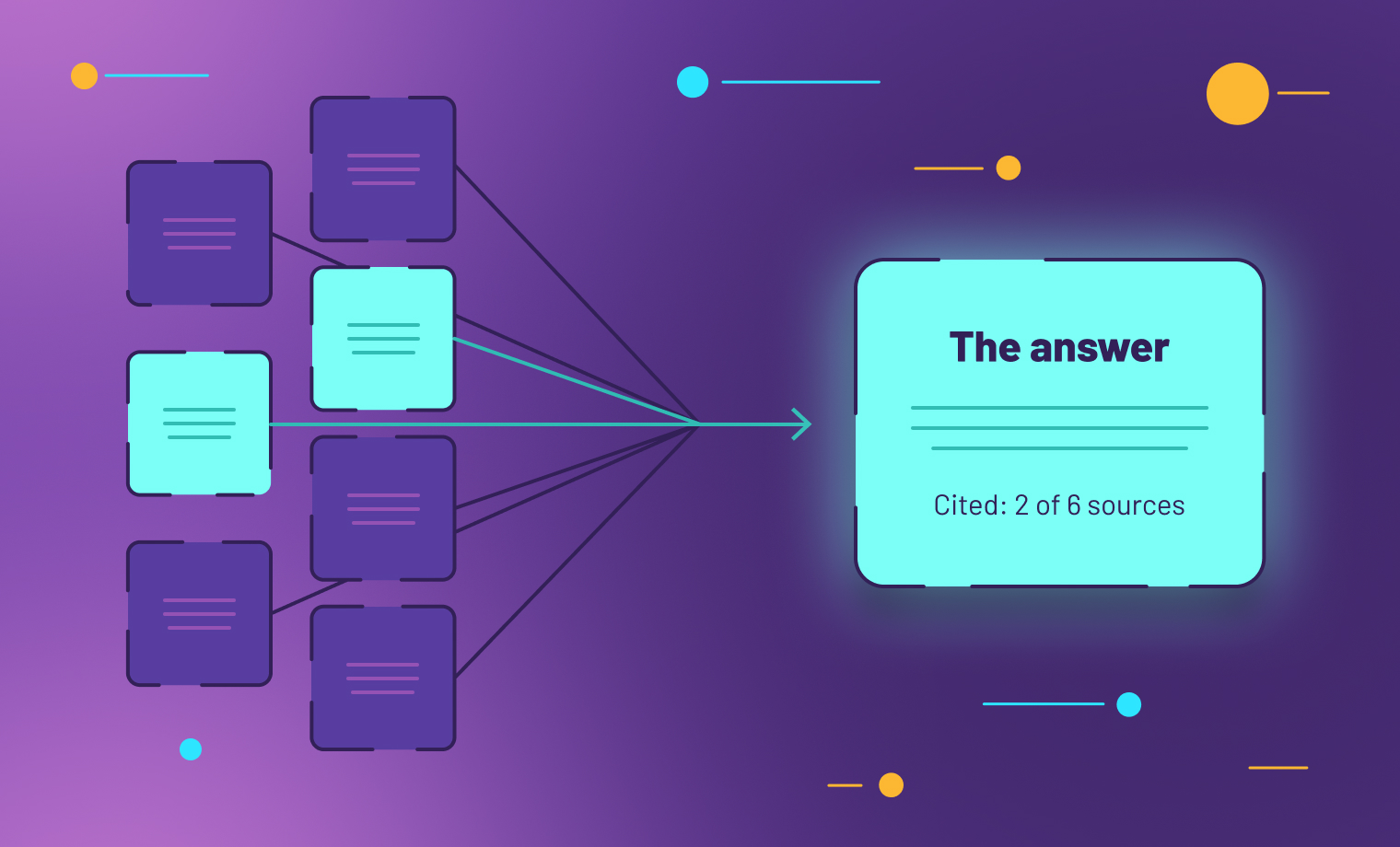
Google’s AI Overviews, ChatGPT, Perplexity, and Copilot all work the same basic way. The engine reads a set of sources, synthesizes a response, and cites a few of them by name. Answer engine optimization for B2B means making sure your content is one of the sources it reads, and one of the few it names.
This is not a replacement for SEO. It runs on the same foundation: crawlable, indexable pages that load fast and make sense. What changed is the payoff. Ranking third used to earn you a click. Now being the source behind the answer earns you the mention, and the click is a bonus.
It is also not the end of your website. Nielsen Norman Group’s research found that people still cross-check AI answers against traditional search, especially when the decision matters. Your buyers still land on your site. They just arrive later, with fewer questions and firmer opinions.
Why This Is a Messaging Problem, Not Just a Technical One
The first instinct is to treat this as a checklist. Add schema markup. Publish an llms.txt file. Chop every page into bite-sized chunks a model can swallow.
Google’s own guidance on optimizing for AI features says not to bother. It tells publishers to skip llms.txt files, skip chunking content into tiny pieces, and skip rewriting specifically for AI systems. The recommendation it gives instead is simpler and harder: publish unique, useful content with a real point of view.
That lands on the message, not the markup.
An answer engine can only summarize what you actually said. If your positioning is a haze of end-to-end solutions and industry-leading expertise, there is nothing specific to pull. The model quotes the competitor who said something concrete instead.
We say a version of this about every channel: fix the message before you fix the channel. AI search just raises the price of vagueness. A human skims past a mushy value proposition. A model leaves it out entirely.
What AI Search Engines Reward
Most of answer engine optimization for B2B comes down to a handful of habits. These are the ones that separate content that gets cited from content that gets skipped.
- Answer the question first. Lead with the answer, then support it. Pages that bury the point rarely get pulled into anything.
- Trade adjectives for specifics. Numbers, timeframes, named methods, and real constraints. “Cuts changeover time by 40%” can be quoted. “Best-in-class efficiency” cannot.
- Structure it for a human reader. Descriptive headings, short sections, one idea per section. Google frames this as organizing content for people, and the machine-readability follows on its own.
- Show your sources and your people. Cite primary research, name the expert behind the claim, and date the piece. Credibility signals matter to models for the same reason they matter to buyers.
- Say the same thing everywhere. Your site, your LinkedIn, your press coverage, your third-party profiles. Answer engines synthesize across sources, and contradictions dilute the picture.
A Quick Self-Check
Three questions you can answer today, without a tool or a budget.
- Ask the engines about yourself. Type “what does [your company] do and who is it for” into ChatGPT and into Google. Read what comes back the way a buyer would. If it is wrong, generic, or about somebody else, you have your starting point.
- Find your top five buyer questions. Can a stranger get a straight answer to each one on your site, in about a screen? If the answer only exists inside a sales call, it does not exist.
- Run the paste test. Take your strongest page and picture a competitor pasting it onto their own site. If nothing breaks, you do not have a visibility problem. You have a differentiation problem.
None of this requires rewriting your site in Q4. In most cases a handful of pages carry the load, the ones that explain what you do, who you do it for, and why it works, and those are the pages to sharpen first.
Answer engine optimization for B2B works best when the message underneath it is already clear. If you want an outside read on where yours stands heading into Q4, reach out to the BFTeam.
