

Over the last several months, I’ve spent a lot of time thinking about what it means to have the right person in the right seat as we continue evolving our agency, and through the massive technological shift being accelerated by AI.
One thing I keep coming back to is how grateful I am for the kind of people we’ve already attracted and retained. Across the board, many of them possess the exact traits that I believe will define who succeeds in this next era of work.
Because the reality is this: Not every white-collar knowledge worker, marketer, advertiser, designer, or client stakeholder is naturally equipped to navigate this transition successfully.
Some people will embrace these tools and thrive.
Others will resist them or struggle to adapt.
And somewhere in the middle is a much larger group whose outcomes will vary depending on their willingness to learn, evolve, and put in the work.
As I think about the individuals most likely to succeed with AI, a few defining characteristics consistently emerge.
The Traits That Separate Who Thrives from Who Doesn’t
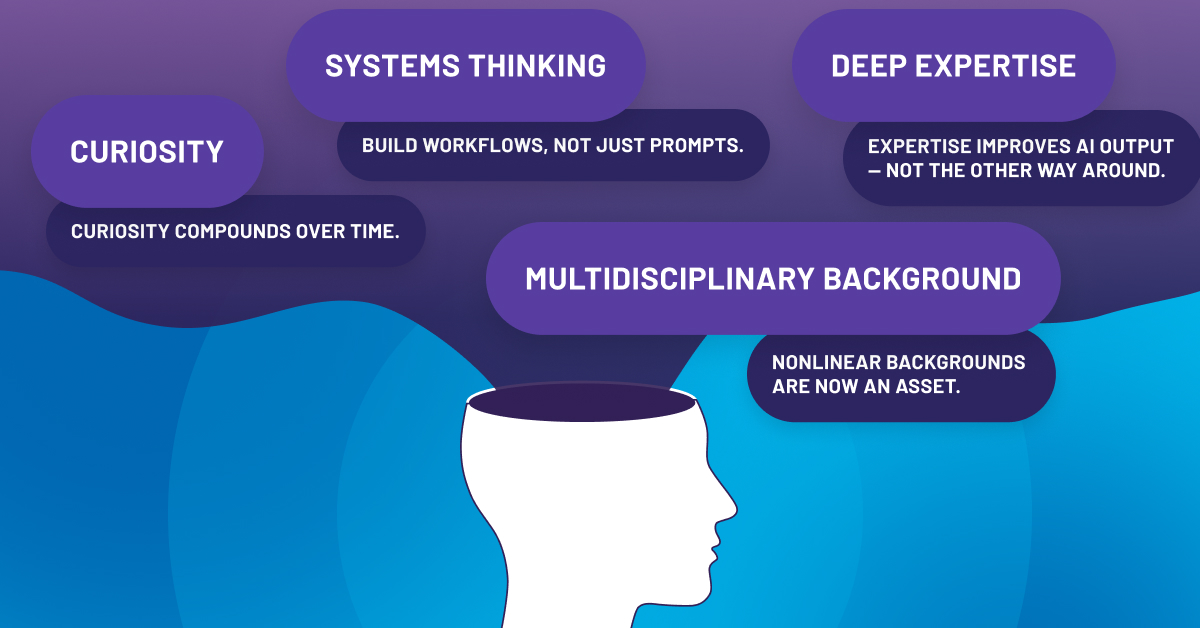
Curiosity: The First Advantage
So many people stop being genuinely curious as they move through life and their careers.
But the individuals who maintain curiosity—especially around technology, systems, and new ways of working—immediately create an advantage for themselves.
They explore. Then experiment. And ask better questions.
And they’re far more willing to rethink how work gets done.
Why Curiosity Compounds Over Time
Curiosity isn’t just a personality trait—it’s a compounding asset.
Every time a curious person experiments with a new tool or workflow, they build a layer of practical knowledge that the next experiment builds on. Over months and years, that accumulation creates a significant gap between those who stayed curious and those who didn’t.
Systems-Level Thinking: The Multiplier
The people who seem to excel with AI tools rarely approach them as simple chatbots that produce answers.
Instead, they think in workflows, frameworks, inputs, outputs, and interconnected systems.
They naturally consider how these tools fit into larger processes. And how they can compound efficiency, creativity, and decision-making over time.
That mindset leads to far more thoughtful and effective implementation.
Using AI Tools as Workflows, Not Chatbots
There’s a meaningful difference between someone who asks AI a question and someone who builds a repeatable process around AI capabilities. The latter aren’t just getting better answers—they’re redesigning how work flows through their organization.
That’s where the real efficiency and competitive advantage live.
Multidisciplinary Experience: The Unexpected Edge
Many of the people adapting fastest to this shift have nonlinear backgrounds or interests that span multiple disciplines—like developers with design backgrounds, musicians turned account managers, strategists who understand operations, or creatives with technical fluency.
There’s often a strong overlap between curiosity, systems thinking, and people who have spent their lives learning across categories rather than staying confined to a single lane.
When Nonlinear Backgrounds Become an Asset
AI tools tend to reward people who can connect dots across disciplines. Someone who understands both strategy and execution, or both creative and data, is better positioned to direct AI effectively. They can evaluate the output from multiple angles at once. The generalist who went deep in a few areas turns out to be exactly who these tools were built for.
Deep Expertise: Still the Foundation
You don’t need decades of experience to benefit from AI. But individuals with meaningful expertise in their field tend to extract significantly more value from these tools.
Over time, experienced professionals accumulate nuanced judgment, pattern recognition, contextual understanding, and tertiary knowledge that AI alone cannot replicate.
Those layers of expertise dramatically improve the quality, refinement, and strategic value of AI-enabled work.
Why Expertise Improves AI Output, Not the Other Way Around
A common misconception is that AI democratizes expertise—that anyone can now produce expert-level work with the right prompt. What we’ve actually seen is the opposite: the more expertise you bring to an AI tool, the better the output becomes. Expertise helps you ask better questions, recognize weak answers, and push the work further. AI amplifies what you already know. It doesn’t replace the knowing.
Almost Anyone Can Succeed (But Not Everyone Will)
Recently, I’ve seen a growing number of LinkedIn posts trying to predict who will and won’t succeed in the AI era. I don’t fully agree with the framing that success can simply be reduced to a checklist of traits.
I believe almost anyone is capable of succeeding with these tools.
But I also believe not everyone will.
Success requires a willingness to adapt, experiment, learn continuously, and endure the discomfort that comes with major technological change.
Some people will make that leap. Others won’t. And naturally, the people who invest deeply in understanding and applying these tools will gain more value from them than those who passively observe from the sidelines.
In many ways, that makes this moment no different from every major technological transition before it.
- There will always be individuals uniquely positioned to take advantage of the shift.
- There will be people who remain average.
- There will be highly successful professionals who fail to adapt.
- And unfortunately, there will also be people already vulnerable in the workforce whose challenges may become even harder as automation reshapes entire categories of work.
That’s the part worth acknowledging honestly.
What This Means for Your Organization
The question isn’t just who on your team will thrive with AI—it’s how you build an environment that makes adaptation possible. That means giving people room to experiment, time to learn, and workflows that actually integrate these tools rather than layering them on top of an already full plate.
At BFT, we’re building AI-enabled workflows into everything we do. Not to replace the expertise on our team, but to make it go further. The goal isn’t AI for its own sake. It’s better work, more efficiently delivered, by people who know what they’re doing.
If you’re a B2B organization trying to figure out how to navigate this transition, that’s exactly what we help with.
Reach out to the BFTeam and let’s talk about where you are and where you need to be.
