
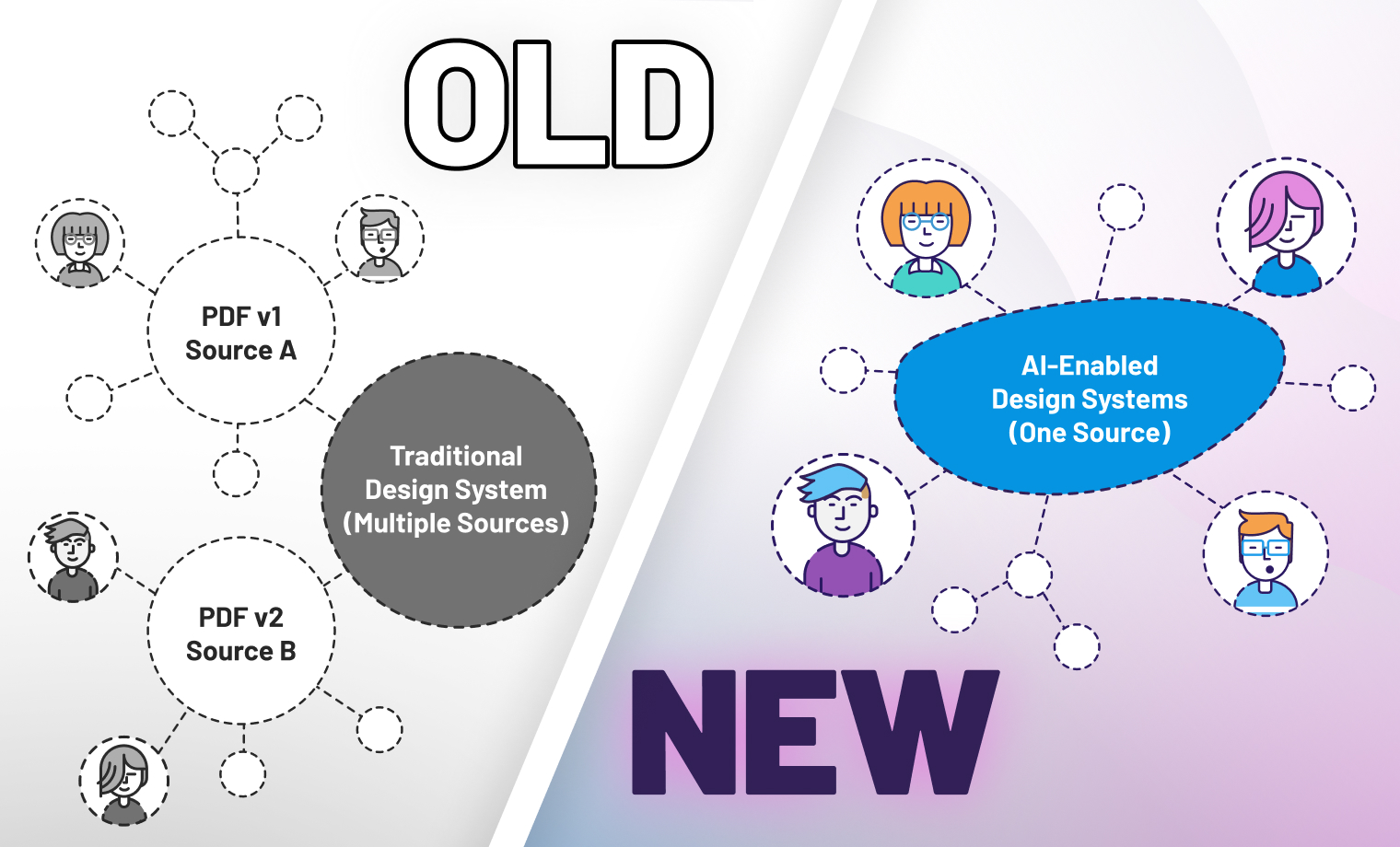


For years, brand standards lived inside static PDF documents—handy for reference, limited in practice.
The problem? Today’s brands don’t operate in a static world. They live across collaborative teams, automated workflows, and increasingly, AI-driven systems.
Old-school guidelines were never built for any of that.
What modern brands need are living, intelligent systems, ones that everyone contributing to the brand ecosystem can actually use. Not just trained designers.
Your brand isn’t being built solely by designers anymore
Look at who’s actually producing branded content inside most organizations today. Strategists. Copywriters. Marketers. Interns. Operations teams. Hardly any of them have formal design training, and most don’t have time to dig through a 90-page PDF before they post.
Now stack the other half of the equation on top: AI agents. They’re generating presentations, campaigns, social graphics, interfaces, and entire digital experiences at scale. Without structured guidance, brand drift isn’t a risk, it’s almost a guarantee.
That’s exactly where AI-enabled design systems become pivotal.
What AI-enabled design systems actually do
Instead of a PDF nobody opens, design systems create a centralized, machine-readable source of truth for everything that makes your brand recognizable: components, typography, iconography, spacing, color, motion, and all the nuanced rules in between.
They give humans and AI systems the same starting line: the ability to produce on-brand work, even when the creator isn’t a design expert. A marketer can spin up a campaign. An AI agent can generate a deck. Both pull from the same logic.
The bigger win? These systems flag conflicts, inconsistencies, and brand drift in real time. Pair them with agentic AI workflows, and you no longer have guidelines.
You have intelligent brand governance.
Enterprise brands have been heading here for a decade
This shift isn’t entirely new.
Large enterprise brands have been investing in password-protected pattern libraries and coded component systems for years—projects that often cost hundreds of thousands of dollars to build and maintain. The infrastructure existed. The intelligence didn’t.
What’s changed is accessibility and intelligence.
AI can now ingest an entire brand ecosystem, aggregate the logic into a unified design system, and apply that understanding across massive contexts and datasets. It can recognize where branding has drifted, surface inconsistencies, and reinforce cohesion across every touchpoint.
The design system becomes two things at once: Both a creative accelerator and an ongoing audit layer for the brand itself.
How we’re putting AI-enabled design systems to work at BFT
This is the work we’re doing inside BFT and for client brands like Ati Motors. The goal isn’t only documentation—it’s an adaptive system that helps every person and every AI interaction contribute to a more consistent, scalable, and intelligent brand experience.
A modern brand isn’t a stack of pages in a PDF. It’s a living system. The brands that treat it that way are the ones that will scale without losing what makes them recognizable.
Ready to modernize your brand standards?
If your brand standards still live in a PDF nobody opens, you’re leaving consistency, speed, and trust on the table.
The shift to AI-enabled design systems isn’t a someday thing—it’s already changing how the best brands operate. Reach out to the BFTeam today and let’s talk about what an AI-enabled design system could look like for you.
