
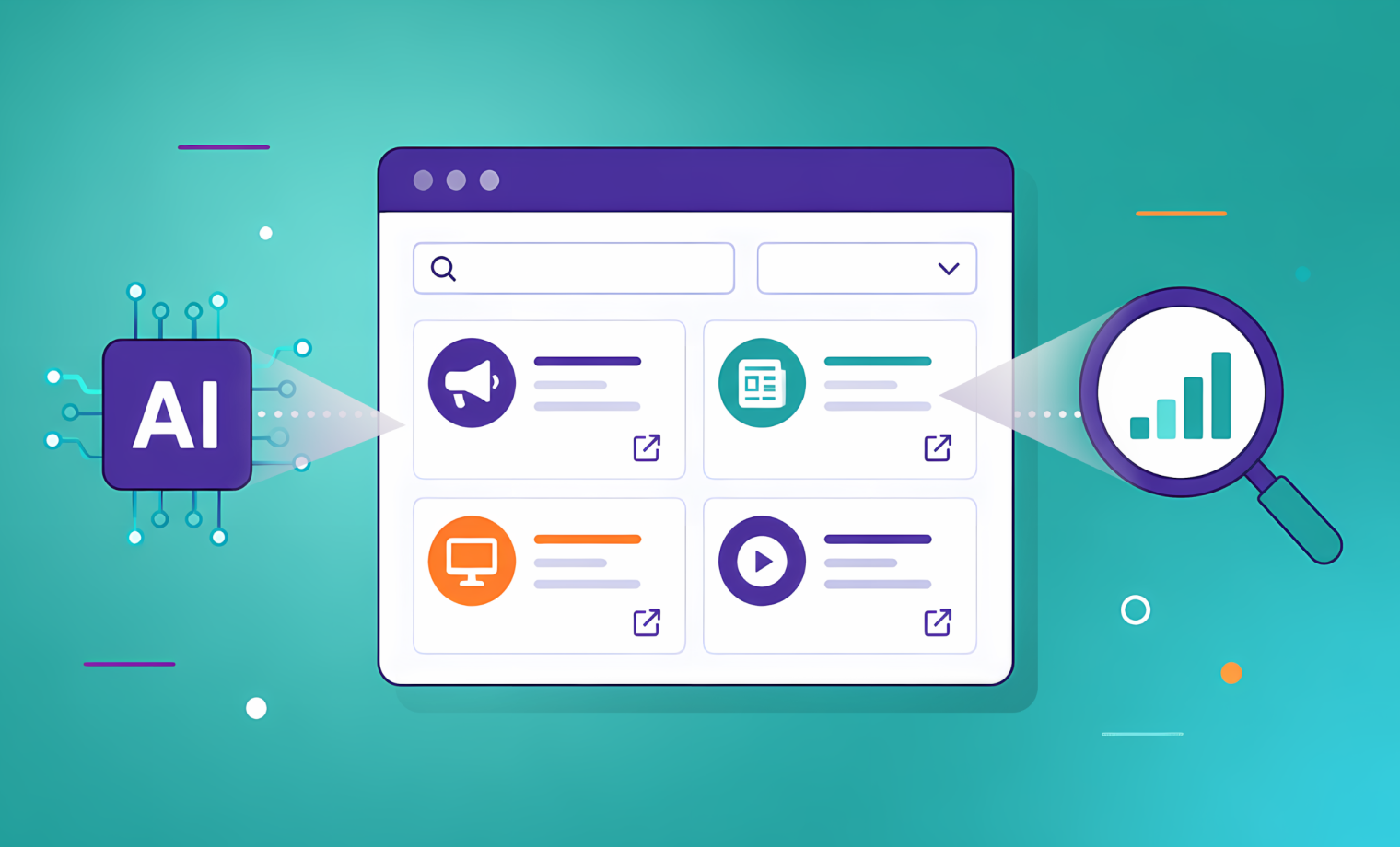

Everyone is talking about AI tools right now. Most of what gets published stays theoretical, because AI can help you streamline research or AI can surface insights faster.
Fewer people discuss the actual build. So we’re going to do that now. (And here is one more of ours).
Learn more about a real tool, what it replaced, and the places where a human still had to step in. Because the lesson we keep relearning with custom AI marketing tools is that the tool is the easy part.
The Problem We Were Actually Solving
Tracking advisor-focused marketing campaigns can create a visibility problem and a time problem.
Much of the activity runs through private portals and gated areas, so it never shows up in a public search. What is visible is scattered…press releases here, trade coverage there, award listings somewhere else. Pulling those fragments into a competitive picture can take hours, and by the time it is assembled, it is already aging.
That was the bottleneck. Not “competitive research is hard,” but specifically: too many sources, no shared structure, and hard to keep the picture current without starting over every quarter.
The Custom AI Marketing Tool We Built
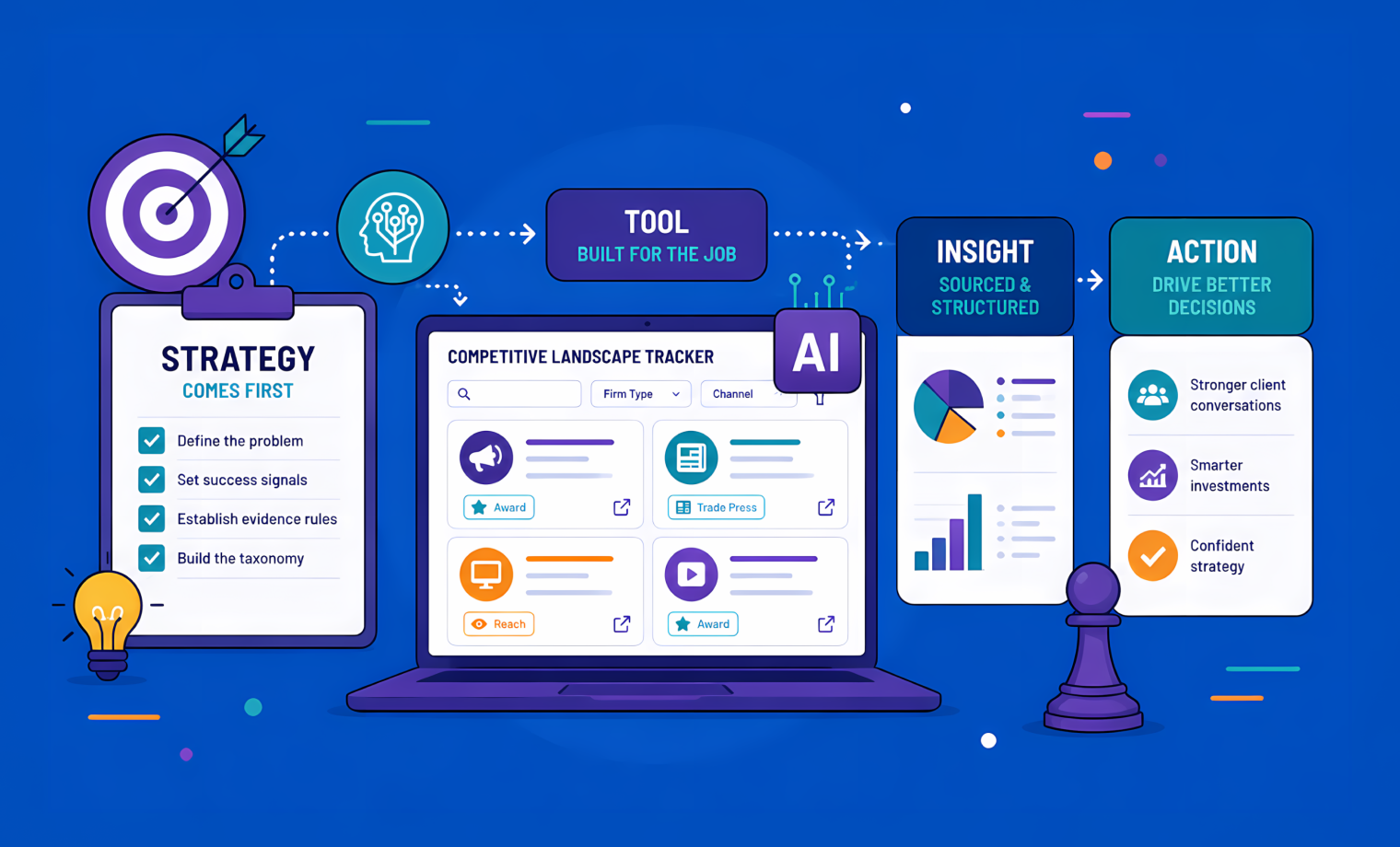
The Competitive Landscape Tracker is a filterable dashboard of verified advisor-marketing campaigns.
Each campaign card answers the same strategic questions: who ran it, firm type, core message, channels, agency partner (if applicable), and traction signals such as awards, trade press, or reach. Each card links to its sources, and the dashboard lets users search, sort, and filter by firm type or channel.
No modeling, no black box. Like most custom AI marketing tools that get used, it solves one job consistently.
Where Strategy Still Comes First
Before building, we had to answer a key question: what counts as campaign “success” when performance data is limited? We chose observable, defensible signals, then built the taxonomy—firm type, key messages, channel, agency—so comparisons would hold up.
The hardest call was evidentiary. Every claim needed a traceable public source: a press release, award listing, or press link. Unverified campaigns came out; unresolved gaps were named.
That part does not automate.
Custom AI marketing tools can assemble, sort, and summarize. They cannot define evidence or flag what is missing.
What Changed
The shift was not just speed. Competitive reviews now start from a structured, sourced view instead of scattered searching, and the output becomes a reusable reference instead of a stale one-off deck.
Quality matters too. With every claim checkable, client conversations can move straight to what the pattern means.
The Takeaway for Other B2B Teams If you are considering custom AI marketing tools for your own team, a few things carried more weight than the technology:
Define “success” before you measure it. In channels with limited performance data, agreeing up front on qualitative signals—awards, press pickup, reach—prevents scope creep later.
Set a sourcing rule and hold to it. Traceable, checkable sources are what make a tool something people trust enough to act on.
Name your blind spots. Being transparent about what you cannot see builds more credibility than presenting an incomplete picture as complete.
Build the taxonomy before the interface. Useful filters depend on having the right categories first.
Solve one bottleneck well. The tools that stick answer a question a team already asks regularly.
We pride ourselves on pairing strategic rigor with tools teams can actually act on.
If competitive visibility is a recurring headache for your team—or you are just trying to figure out where AI genuinely fits into your workflows—reach out to the BFTeam to talk it through.
