



Last year’s plan assumed AI would buy your team time. Did it?
Answer that honestly before you open a blank doc and start your 2027 B2B marketing plan. For many lean B2B marketing teams, the hours AI saved made it easier to see where to focus. It also created room to take advantage of new opportunities—podcasts, posts, drafts, and dashboards—as they came up.
The challenge is deciding how to use that capacity well. That’s a planning problem, not a tool problem. And it’s fixable, once you’re clear about which parts of the marketing plan AI can carry and which parts still need a person in the room.
What Actually Shifted in 2026
Three things changed enough to matter for next year’s planning.
Search started answering instead of routing. Buyers now get a synthesized answer from Google’s AI Overviews, ChatGPT, or Claude before they ever reach your site. They haven’t abandoned traditional search, though. Nielsen Norman Group’s research found people use AI alongside search, not instead of it. Your website still matters. It just has to earn its way into the answer first. (We dug into this in our post on answer engine optimization.)
Production capacity went way up. A small team can now draft, resize, and repurpose at a pace that used to take a much bigger one. The bottleneck moved. The question isn’t “Can we make it?” anymore. It’s “Should we?”
Reporting got loud. Every platform now gives an AI summary of its own performance, and most teams have more dashboards than anyone has time to read. More inputs didn’t automatically mean better decisions. Sometimes it just meant longer meetings.
What AI Should Absorb in Your 2027 Plan
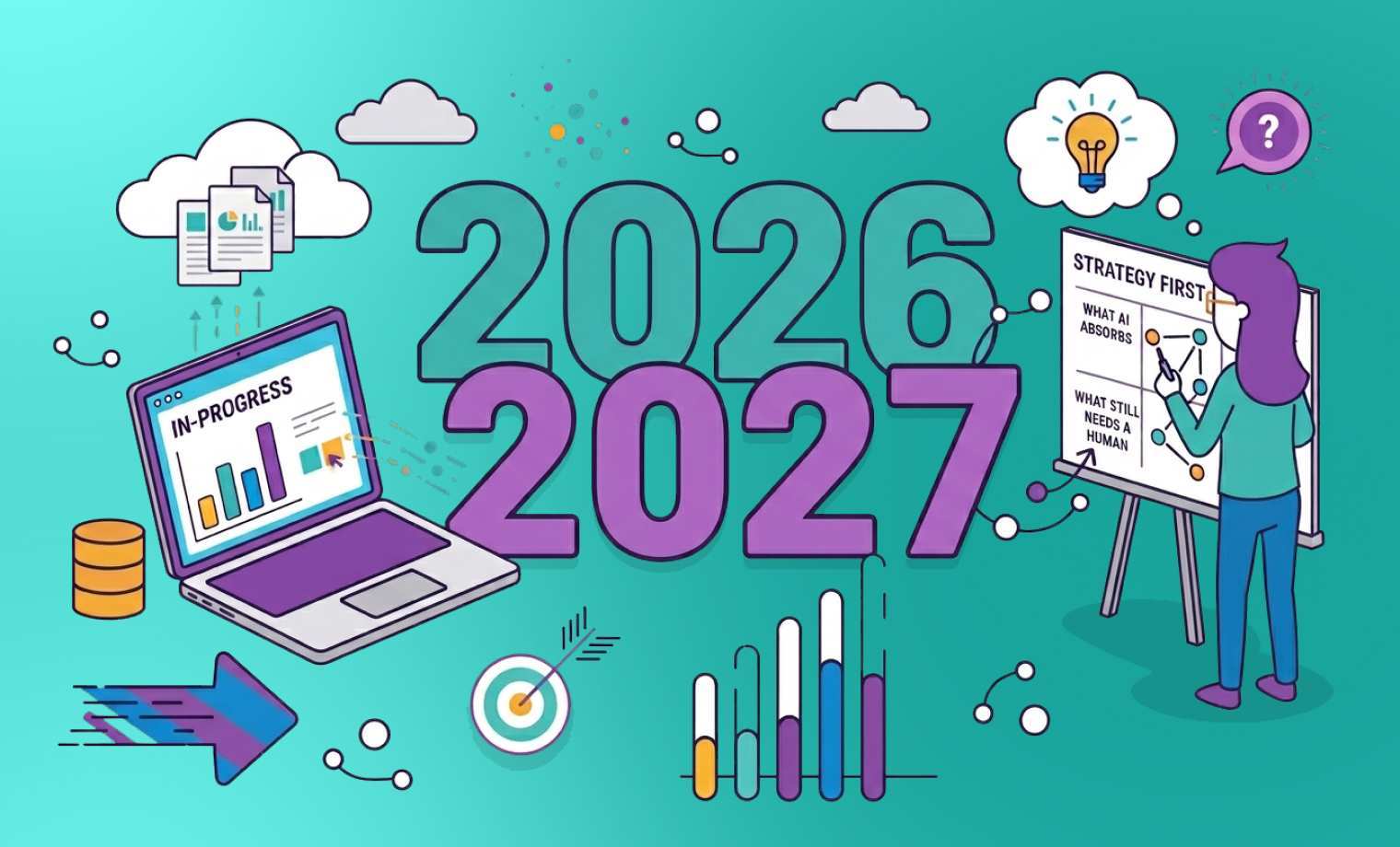
If a task is repeatable, well-defined, and easy to check, it belongs on AI’s side of the ledger. In your 2027 B2B marketing plan, that usually means:
- Research synthesis. Pulling competitor messaging, industry news, and customer reviews into a first-pass summary your team can react to.
- First-draft production. Outlines, ad variations, email drafts, and social copy that start at 60% instead of zero. (The last 40% is still yours.)
- Repurposing. Turning one webinar into a blog post, a handful of LinkedIn updates, a newsletter section, and a sales one-pager.
- Reporting assembly. Pulling numbers from four platforms into one view, so the meeting is spent making decisions instead of copying and pasting.
Notice what these have in common. Each one ends with a human checkpoint. AI does the assembly. Someone on your team still decides whether it’s right.
What Still Needs a Human Strategist
Here’s the part no tool will do for you, no matter how good the prompt is.
Audience definition. AI can tell you who’s searching. It can’t tell you which of those people deserve your limited budget, or which accounts your sales team will actually follow up on. That takes judgment and a few honest conversations with sales.
Differentiation. A model trained on everything tends to sound like everything. If your positioning already sounds like the industry average, AI will happily help you produce more of it. Finding the thing only you can say is still human work.
The message. What you want a buyer to believe, in what order, and why they should believe you. Every channel in the plan hangs on this, so it has to be settled before anything gets produced.
What you’re not doing. This is the hardest call in any plan, and the one most teams skip. AI makes it cheap to say yes to every channel. A strategist’s job is to say no to most of them, so the few that remain get done well.
AI does the assembly. Someone on your team still decides whether it’s right.
Plan the Strategy First, Then the Stack
We say this a lot, so bear with us: fix the message before you fix the channel.
It applies to tools, too. One of the easiest traps in 2027 planning is building the plan around the software you already bought. You signed an annual contract for an AI content platform last spring, so now the plan has to include a lot of content.
Start with the outcomes your 2027 B2B marketing plan needs to deliver, the audiences that drive those outcomes, and the message that moves those audiences.
Then look at your stack and ask which tools serve that plan. Some will. Some will turn out to be very expensive ways to make things nobody asked for.
Audit Your 2026 Plan Before You Write the Next One
Before you write anything new, sit down with last year’s plan and four questions.
- What actually worked? Not what kept the team busy. What produced pipeline, conversations, or deals your sales team would point to.
- What did AI really save? Count the hours, then ask where they went. If they went into more output, was the output worth it?
- What did you skip? The messaging refresh, the customer interviews, the strategy work you meant to get to in Q2. Those gaps tend to show up in next year’s results.
- What would you cut? If you had to drop one channel, one tool, or one recurring report tomorrow, which one would nobody miss?
Your answers are the rough draft of your 2027 plan. Most of the strategy is already sitting in them, and turning that into a working plan is exactly what our marketing plans work is built for.
AI will carry more of the work in 2027. The thinking is still on us. Want a strategist across the table while you build your 2027 B2B marketing plan? Reach out to the BFTeam and let’s talk it through.
