30 Days. A New Market. A Website Built With AI as a Teammate.
Claude as a co-developer. A 30-day build. A new playbook for how Blue Flame Thinking works with AI.


A new market. A new tool. A new process. Disrupting workflows.
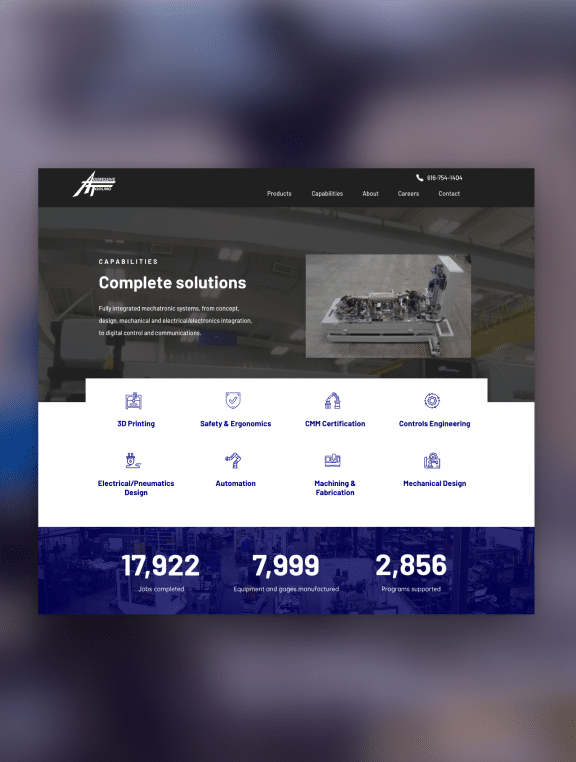
Ati Robotics was ready to make a serious move into the U.S. market—and needed a website to build credibility for the brand. That was the brief. The harder part was everything we were figuring out at the same time.
The disruption wasn’t the client. It was the workflow. Introducing Claude in Cowork mode as a primary collaborator meant learning a new system while actively running a project—and while the rest of our client work kept moving. Context-switching between our established workflow processes and the new way, on parallel projects, is where things got genuinely hard.
8 weeks
of strategy, discovery, and competitive research completed before the build phase began.
26
pages built and sent—sitemap to production—in 30 days.
0
shortcuts taken on strategy. Every phase of the normal BFT process ran. AI compressed execution, not thinking.
The process didn’t change. The way we ran it did.
We didn’t replace the BFT methodology with AI. We ran every phase of it—discovery, competitive analysis, wireframes, design, build, QA, launch—with Claude as an active collaborator.
Strategy & foundation
Weeks of brand audits, buyer mapping, and competitive scraping. The kind of work AI can support but can’t do for you—and what made the fast build possible.
Co-built execution
The BFTeam knew when Claude drifted on messaging or audience. Design used AI to expand existing photography for specific industries, applications, and settings.
Ship & iterate
Every change committed, deployed to staging, reviewed, and promoted. The flow stayed the same—only the speed and the number of hands on the keyboard changed.
Every session started with CLAUDE.md.
Claude ran in Cowork mode on a BFTeam member’s desktop, with direct read and write access to the GitHub repository and a sandboxed Linux shell. It edited real files, ran builds, wrote commit messages, and flagged broken shortcodes before they shipped. A single file—CLAUDE.md—sat at the root of the repo and loaded automatically at the start of every session, encoding project context so we didn’t have to reteach the AI what it already knew.
One markdown file at the repo root—offering client context, git conventions, CSS architecture, brand copy rules, accessibility baselines, and a short list of things Claude should never do without flagging. It’s how we encoded institutional knowledge so each session picked up where the last one left off.
From sitemap to design, in one continuous pass.
Before Claude touched a line of code, the structure of the site was already decided. Sitemap drove wireframes. Wireframes drove design. Each stage carried forward—nothing got reinvented at the next step.
The discipline came from doing each phase fully before moving on, not collapsing them into a single rushed pass. AI compressed the time inside each phase. It didn’t let us skip the transitions between them.
Sitemap
26 pages mapped before a wireframe existed. Every page had a job, a primary audience, and a place in the funnel—so nothing was built that didn’t need to exist.
Wireframes
Structure before style. Wireframes locked the content hierarchy, the CTA placement, and the section logic—so the design phase collaborated about typography and color, not about whether a section belonged.
Design
By the time design pixels mattered, the hard decisions were already made. Design dialed in tone, type, color, and animation, with the sitemap and wireframes already solid.
Staging to production in 60 seconds.
No exceptions.
Every change—copy tweak, new page, structural fix—followed the same path. No “quick fixes” in production.
Netlify auto-deployed on every push. The staging URL was the client’s live review environment.
Claude handled edits during the call, ran a local build to verify, had changes on staging before we hung up.
The discipline of the flow mattered as much as the speed. Speed without discipline is just chaos that ships faster.

The stack behind the 30-day build.
Eleventy generates the pages. Netlify deploys them. GitHub holds the history. Claude sits in the middle—reading files, writing code, running builds, and working within conventions it learns once and carries forward.
Claude Cowork
Claude ran on a BFTeam member’s desktop with direct file and repo access. Not a chat window—a co-developer that reads, writes, builds, and commits right alongside you.
GitHub Connector
The GitHub integration gave Claude live repo context. It understood branch state, the staging–main flow, and our commit conventions—so it worked within the system instead of around it.
Eleventy + Netlify
Static site generator, markdown content files, Tailwind CSS, auto-deploys on push. Simple parts, deliberately chosen. Nothing locked in—the whole stack can migrate to any CMS without a rebuild.
We thought the hardest part would be the website. It turned out the hardest part was learning a new way to work—in the middle of an active project, with other clients depending on us. We had to figure out how to work in two workstreams at the same time. Our traditional client work had to run in parallel to the Claude build with Ati Robotics.Blue Flame Thinking — Ati Robotics Project Team
It disrupted everything. The knowledge gain was infinite.

Adding a new AI-assisted workflow to a live project calendar was harder than we expected. The context-switching, the learning curve, the sessions that ran long — all of it landed on top of existing client commitments that didn’t pause for us to figure out a new way of working.
What got us through it was process discipline. CLAUDE.md kept sessions from spinning. The staging branch kept experiments from breaking production. Conventional commits kept the history legible when context had to transfer. The friction was real. So were the results: 26 pages, two environments, ~60-second deploys, and a client entering a new market with a site that matches their ambition.
A 30-day build. A new internal playbook. A client in a new market.
The Ati Robotics site went live on time, at the quality bar we set at the start. It’s the foundation the client will keep building on as they scale U.S. operations—and the blueprint BFT is carrying into every AI-assisted project that comes next.